Knowledge
Key Factors When Selecting High Force Pneumatic Cylinders for Automation Systems
2026/ 05/ 13
As industrial automation systems become faster, more compact, and more demanding, the need for reliable linear motion solutions continues to increase. In many applications, standard pneumatic cylinders may not provide sufficient force, stability, or durability for heavy-duty operation. This is why many equipment manufacturers turn to high force pneumatic cylinders for advanced automation systems.
High force pneumatic cylinders are widely used in machine tools, automated fixtures, robotic handling systems, transfer equipment, and high-cycle production lines. However, selecting the correct cylinder involves more than simply choosing the largest bore size available. Engineers must carefully evaluate force requirements, installation space, cycle frequency, mounting conditions, and long-term reliability.
At HINAKA, pneumatic cylinder solutions are developed to support demanding industrial automation environments where stable force output and efficient machine integration are essential. This article explores the key engineering factors that should be considered when selecting high force pneumatic cylinders for automation systems.
Understanding the Force Requirements of the Application
The first step in selecting a high force pneumatic cylinder is determining the required output force.
Cylinder force is primarily affected by:
-
Operating air pressure
-
Piston bore size
-
Rod diameter
-
Internal friction losses
In industrial automation systems, the required force depends on the application itself. For example:
-
Clamping systems require stable holding force
-
Transfer systems require pushing force
-
Robotic gripping systems require controlled gripping pressure
-
Tool change systems require strong unclamping force
Engineers should also include a safety margin to account for pressure fluctuation, friction, and load variation during operation.
Selecting a cylinder without sufficient force capacity may lead to unstable operation, vibration, or premature wear.
Bore Size and Force Density
Increasing bore diameter is the most direct way to increase pneumatic cylinder force. However, larger cylinders also require more installation space and air consumption.
In modern automation systems where machine layouts are increasingly compact, engineers often need to balance:
-
High force output
-
Compact design
-
Fast response speed
-
Efficient energy consumption
This is why force density has become an important consideration in pneumatic cylinder design.
Compact high force pneumatic cylinders can provide strong output while minimizing machine footprint, making them suitable for automated production equipment with limited installation space.
Evaluating Operating Pressure Conditions
Operating pressure directly affects pneumatic cylinder performance.
Most industrial pneumatic systems operate within a standard compressed air range, but actual pressure conditions may fluctuate depending on:
-
Compressor capacity
-
Air supply distance
-
Simultaneous actuator usage
-
System leakage
When selecting high force pneumatic cylinders, engineers should ensure that the cylinder can maintain stable performance within the actual operating pressure range of the automation system.
For applications requiring extremely high force output, boosting mechanisms or air hydraulic systems may provide better performance than standard pneumatic structures.
Considering Installation Space and Mounting Configuration
Automation equipment often includes multiple actuators, sensors, tooling systems, and guarding structures within limited machine space.
As a result, cylinder mounting flexibility becomes an important design factor.
Engineers should evaluate:
-
Available installation dimensions
-
Stroke length limitations
-
Mounting orientation
-
Side-load conditions
-
Maintenance accessibility
Compact cylinder structures are especially useful for high-density automation layouts where machine footprint reduction is a priority.
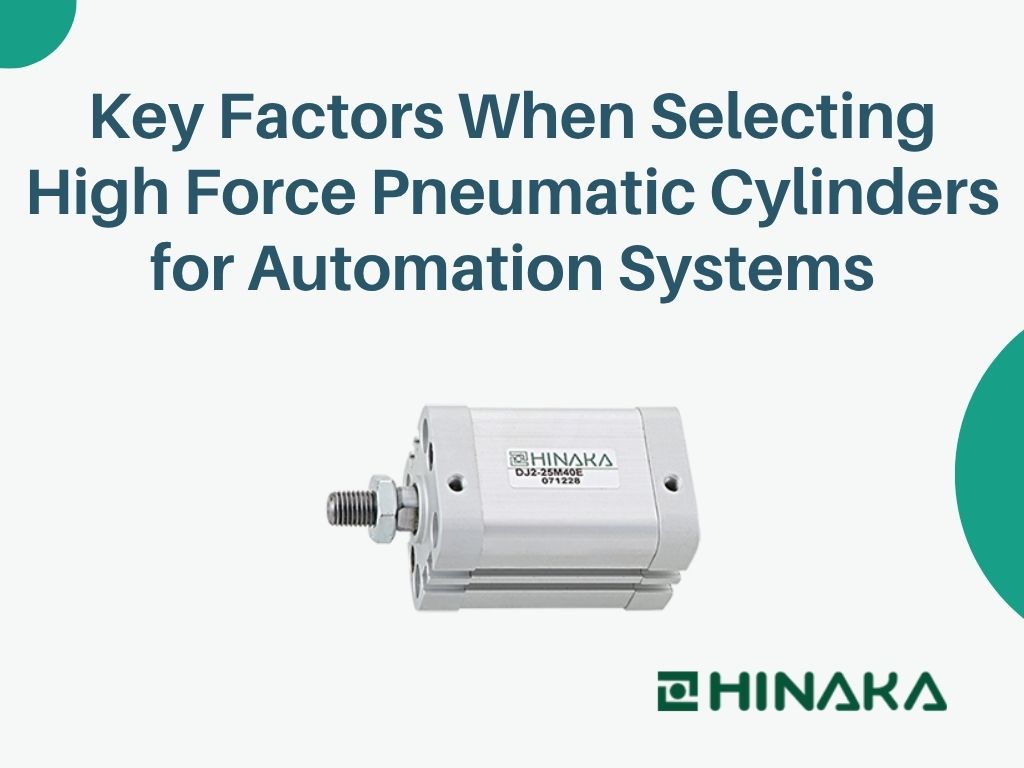
HINAKA’s DJ2 Series Compact Pneumatic Cylinders are designed for these environments, providing stable motion and compact installation flexibility for automated machinery.
Cycle Frequency and Long-Term Durability
High-cycle automation systems place significant stress on pneumatic components. Cylinders operating continuously under repetitive motion conditions must maintain stable force output and sealing performance over extended periods.
Key durability considerations include:
-
Seal quality and wear resistance
-
Internal guidance stability
-
Rod surface treatment
-
Lubrication condition
-
Structural rigidity
Selecting a cylinder designed for high-cycle operation helps reduce maintenance frequency and minimize unexpected downtime.
For demanding industrial environments, reinforced structures and durable sealing systems are essential for long service life.
Response Speed and Motion Stability
Automation productivity is heavily influenced by actuator response speed.
Pneumatic cylinders are known for fast motion response, but high force applications also require stable movement and accurate positioning.
Improper cylinder selection may result in:
-
Excessive impact at stroke end
-
Vibration during movement
-
Unstable clamping force
-
Reduced positioning accuracy
Proper cushioning design and controlled motion characteristics help improve overall automation performance.
When to Consider Boosting Cylinder Technologies
In some automation systems, standard pneumatic cylinders may not provide sufficient force for heavy-duty clamping or tool-change operations.
This is especially common in:
-
CNC machining centers
-
Automatic tool change systems
-
Heavy fixture clamping systems
-
High-force release mechanisms
In these situations, boosting cylinder technologies can provide higher force output without dramatically increasing cylinder size.
HINAKA’s BPT Series Tool Change Boosting Unclamping Cylinders are designed to convert compressed air into stronger unclamping force through internal boosting mechanisms.
Key features include:
-
High force output in compact structures
-
Fast response for automation systems
-
Stable unclamping performance
-
Lightweight modular construction
-
Suitable for CNC machine tool applications
These characteristics make boosting cylinders ideal for automation systems requiring strong and reliable force output in limited space.
Common Selection Mistakes in Automation Systems
When selecting high force pneumatic cylinders, some common engineering mistakes include:
-
Choosing cylinders based only on bore size
-
Ignoring side-load conditions
-
Underestimating cycle frequency
-
Insufficient safety margin
-
Neglecting maintenance accessibility
-
Overlooking pressure fluctuations
A properly engineered selection process helps improve both machine reliability and long-term operational efficiency.
Frequently Asked Questions (FAQ)
What is a high force pneumatic cylinder?
A high force pneumatic cylinder is designed to generate greater output force than standard pneumatic cylinders through optimized bore design, force density, or boosting mechanisms.
How do I calculate pneumatic cylinder force?
Cylinder force is calculated based on operating pressure and piston area. Engineers should also consider friction loss and include a safety margin for stable operation.
Are compact pneumatic cylinders suitable for heavy-duty automation?
Yes. Compact pneumatic cylinders can provide strong force output while reducing installation space, especially in modern automation systems with limited machine layouts.
When should boosting cylinders be used?
Boosting cylinders are suitable when standard pneumatic force is insufficient for applications such as CNC tool unclamping, heavy clamping systems, or high-force automation mechanisms.
Conclusion
Selecting the correct high force pneumatic cylinder is critical for achieving stable and efficient automation performance. Factors such as force requirements, pressure conditions, mounting configuration, cycle frequency, and durability all influence long-term system reliability.
As automation equipment continues to become more compact and performance-driven, advanced pneumatic cylinder technologies help manufacturers balance force output, response speed, and installation efficiency.
HINAKA provides compact pneumatic cylinders and boosting cylinder solutions designed for modern industrial automation systems. If you are evaluating high force pneumatic cylinder solutions for machine tools or automation equipment, feel free to contact HINAKA for technical consultation and product recommendations.
Recent Article
- Hydraulic Cylinder Maintenance Guide: Preventing Leaks, Corrosion, and Seal Failure
- The Role of Hydraulic Cylinders in Precision Manufacturing and Robotics
- Comparing Air Hydraulic Unclamping Cylinders and Mechanical Clamping Systems
- Hydraulic Cylinders in Heavy-Load Automation: Designing for High Force and Long Service Life
- Selecting Hydraulic Cylinders for Mobile Machinery: Shock, Vibration, and Contamination Challenges